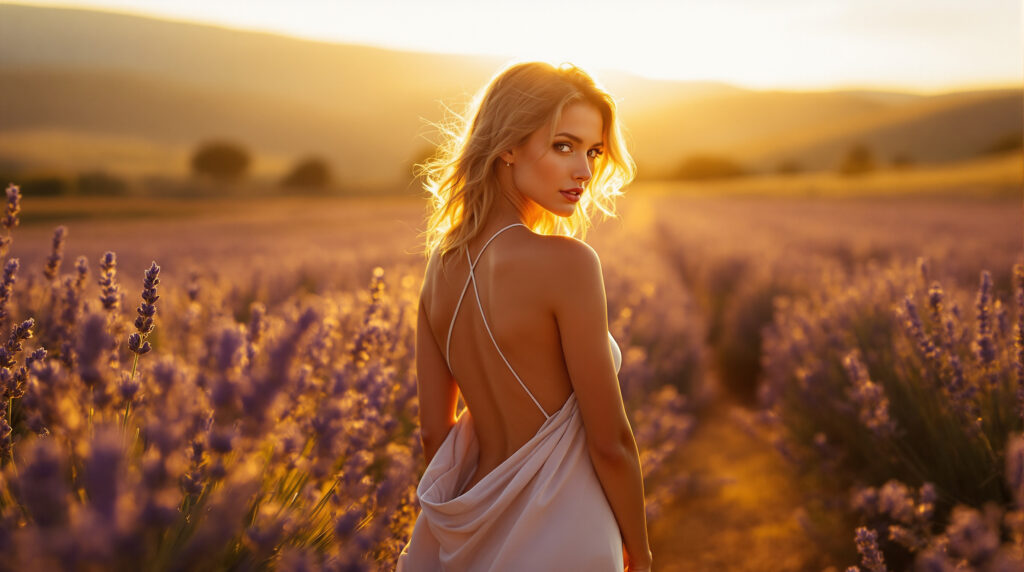
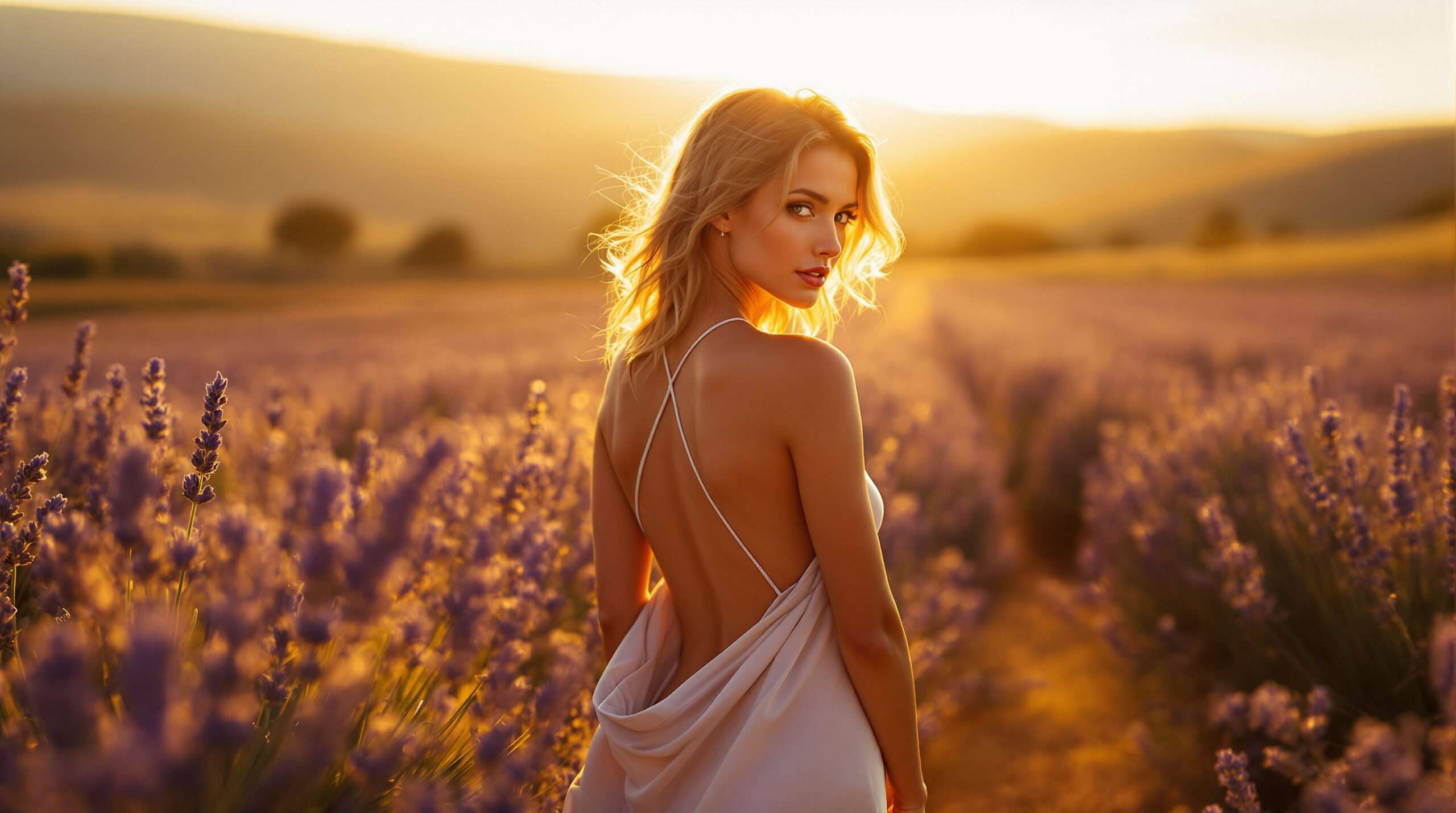
There is a particular hour in late August, here in the south of France, when the heat finally relents and the lavender fields release their last perfume into the cooling air. The cicadas, having screamed their desire at the sun all day, fall suddenly silent. And in that silence — that golden, honeyed pause between day and night — I become something other than a woman with a name and a history and a list of things to do.
I become a body. Simply, radically, gloriously a body.
This is the hour I walk naked through the fields behind my house. Not for anyone’s gaze. Not for a photograph, though I have occasionally been tempted. Not even for the pleasure of the sun on skin I know so intimately after forty-some years of living in it. I do it because this — this shedding of fabric, this unselfconscious inhabitation of one’s own physical self — is the most honest conversation I have ever had with desire.
And if you’ve read my books, you know I’ve had quite a few conversations with desire.
The Swedish Girl Who Learned to Hide
I was not born into this freedom. I was born in Sweden, where the relationship with the body is — how shall I put this? — pragmatic. Swedes are not prudes. We have saunas, we have communal changing rooms, we have a cultural understanding that bodies are bodies and there is no particular shame in them. But there is also, beneath that practicality, a reserve. A politeness. A sense that one does not linger on the body. One does not revel.
I spent my twenties learning to hide in plain sight. I wore clothes that flattered but never revealed. I held my shoulders in a certain way. I laughed at jokes about sex but never spoke of my own wanting. I wrote, always secretly, the stories that pulsed behind my ribs — stories of women who did linger, who did revel, who let their wanting fill a room like perfume. But I published none of them. I was not yet the woman who could stand behind those words.
It took moving to France to begin the unlearning. It took falling in love with a man who looked at me — truly looked, without flinching, without the polite Swedish aversion to intensity — and said, “You are so much more than you allow yourself to be.”
And it took discovering naturism.
The First Time I Stood Naked in the Sun
I remember it with the kind of clarity we reserve for life’s hinge moments. A small, secluded beach near Cap d’Agde — not the famous one, not the tourist circus, but a quiet cove a local friend had told us about. My husband, already comfortable in his skin in the way of men who have done physical work their whole lives, undressed without ceremony and walked into the water.
I stood on the sand, clutching my sarong like a life raft.
What was I afraid of? Not being seen — there was no one there to see. No, I was afraid of something far more intimate: being seen by myself. Encountering my body not as an object to be dressed and adorned and presented, but as a living, breathing, animal thing. A thing that sweated and stretched and bore the marks of its years. A thing that wanted, whether I permitted it or not.
I dropped the sarong.
The sun touched my skin everywhere at once — shoulders, breasts, belly, the soft inside of my thighs — and I understood, in a rush that was almost vertigo, that I had never actually felt my own body before. I had been living in it like a tenant, not an owner. I had been polite with it. I had been Swedish.
I walked into the water, and the Mediterranean — warm, salt-soft, ancient — received me like a lover who had been waiting a very long time.
What Clothes Do to Desire
Here is a proposition that took me years to articulate but that now sits at the very centre of how I write, how I love, and how I live: clothes are not just fabric. They are a form of editing.
Every garment we put on makes a decision about what we will reveal and what we will conceal. A neckline says this much. A hemline says this much. A waistline, a sleeve, a slit, a sheer panel — each is a negotiation between the self we offer the world and the self we keep private. And there is nothing wrong with this. I love clothes. I love the theatre of dressing, the art of suggestion, the way a silk robe sliding off one shoulder can be more erotic than full nudity.
But here is what I also know: you cannot fully understand what you want to reveal until you have experienced what it means to conceal nothing at all.
Naturism taught me that desire is not about the unveiling. It is about the presence that precedes it. When you have spent hours naked in the sun, when you have swum and walked and napped and read and made love without the mediation of fabric, you learn something profound: your body is not a secret to be kept. It is a landscape to be inhabited.
And when you return to clothes — when you pull on that linen dress, when you fasten those sandals — you do so not from shame but from choice. The dress becomes a frame, not a cage. The neckline is an invitation, not a negotiation. You are not hiding anymore. You are composing.
This is the difference between a woman who wears her clothes and a woman who is worn by them. And it is the difference, I would argue, between pornography and erotica. One reveals because it must. The other reveals because it chooses to.
The Body Knows Before the Mind Does
There is a scene in Sailing into Desire where the heroine, Liv, stands at the bow of a yacht in the Greek islands, the wind flattening her thin cotton dress against her body, and she realises — not thinks, not decides, but realises in her skin — that she is about to surrender to a passion she has been running from for years.
I wrote that scene sitting naked on my terrace, a linen sheet pooled around my hips, the morning sun warming my shoulder blades. And I wrote it that way because I have learned to trust the body’s intelligence. The body knows what it wants long before the mind has assembled a respectable argument for it. The body recognises a lover’s scent before the brain has catalogued his virtues. The body tightens, softens, opens, resists — and if we are paying attention, it tells us everything we need to know about whether we are moving toward life or away from it.
Naturism sharpens this intelligence. When you are naked outdoors — when your skin is in constant, unfiltered conversation with air and sun and the slight roughness of the wooden chair beneath your thighs — you cannot ignore what your body is telling you. There is no fabric to muffle the signal. There is no social costume to perform in. There is just you, and the million tiny sensations that make up being alive, and the slow dawning awareness that desire is not a switch you flip but a current you are always swimming in.
Some of you will resist this idea. I understand. We have been taught — especially those of us who were raised as girls — that the body is a problem to be solved. Too much. Too little. Too soft. Too loud. We diet it, we dress it, we discipline it, we apologise for it. The idea that the body might be a source of wisdom feels almost heretical.
I am here to tell you: it is the most orthodox truth there is.
What the Lavender Fields Taught Me About Eroticism
Provence in late summer is an education in the senses. The lavender harvest has just ended, but the fields still hold their ghost — that sharp, clean, almost medicinal sweetness that hangs in the air like a memory of purple. The earth is dry and cracked in places, releasing a mineral scent after the evening watering. The figs on the tree by my kitchen door are so ripe they split open at the slightest touch, oozing their honeyed juice. The tomatoes taste of sunshine and soil and something that cannot be named.
This is eros. Not the narrow, clinical definition of sexual activity, but the older, deeper, Greek understanding: eros as the force that draws living things toward what makes them more alive.
The fig reaches toward the sun. The bee buries itself in the lavender. The woman walks naked through the field at dusk, and every cell of her body sings.
When I write erotic scenes — and those of you who have read The Art of Seduction know I do not shy away from them — I am not writing about mechanics. I am writing about this. The pull. The ripening. The unbearable sweetness of wanting something you are not yet allowed to have. The way a lover’s hand on the small of your back can feel like the first rain after a drought. The way a glance held a beat too long can undo you more thoroughly than any touch.
This is what the lavender fields taught me: that eroticism is not a subcategory of experience. It is the lens through which all experience becomes vivid. And you do not need to be naked in a field to access it — though I highly recommend it — but you do need to let your senses lead sometimes, rather than always following the dull, dutiful orders of your calendar and your to-do list and your sensible internal monologue.
On Being Seen — Really Seen
The most common objection I hear when I mention naturism is some variation of: “But I don’t want anyone to see me.”
I want to be gentle with this, because I know how deep that fear runs. We live in a culture that trains women, in particular, to believe that our bodies are acceptable only insofar as they meet a narrow and constantly shifting standard. We absorb this poison so early and so thoroughly that we mistake it for our own voice. We think the shame is ours.
Let me tell you what I have observed, in years of beaches and resorts and quiet afternoons on my own terrace: nobody is looking at you the way you are looking at you.
The naturist community — and I mean the real one, not the performative one that occasionally makes the news — is one of the least judgmental environments I have ever encountered. Bodies are bodies. Old bodies, young bodies, scarred bodies, soft bodies, bodies that have carried children, bodies that have survived illness, bodies that are still becoming whatever they are going to become. They are all just there, unremarkable and miraculous at the same time, like trees in a forest.
And something shifts when you spend time in this environment. You stop comparing. You stop cataloguing flaws. You start seeing people — the warmth in someone’s eyes, the laugh lines around their mouth, the way they gesture when they’re telling a story. The body becomes a medium for the self, not a mask for it.
This, too, is an education in desire. Because the most erotic thing in the world is not a perfect body. It is a present body. A body that is not apologising. A body that is not performing. A body that is just here, fully inhabited, fully alive.
I have tried to put this quality into every heroine I have ever written. Elara in Beneath Pharaoh’s Curse — brilliant, stubborn, afraid of nothing except her own heart. The unnamed narrator of Night Visitor — who discovers that the deepest intimacy sometimes arrives in the dark, without names, without history, without anything but breath and skin. These women are not perfect. They are present. And that presence, I have come to believe, is the real secret of erotic power.
Bringing It Home: How to Find Your Own Golden Hour
I am not going to tell you to book a ticket to the south of France — though you should, if you can. The lavender will wait. The Mediterranean will wait. The figs will wait.
What I am going to tell you is that you can start right now, tonight, in the privacy of your own home, with nothing but your own skin and a willingness to be uncomfortable for a few minutes.
Close the curtains if you must. Lock the door. Take off your clothes. Not for a shower, not for sex, not for any practical purpose — just to be. Stand in the middle of your bedroom and feel the air on your skin. Notice where you instinctively cover yourself. Notice what thoughts rise up — the criticisms, the shoulds, the old scripts. Let them rise. Let them pass. Keep standing there.
This is the beginning. Not of exhibitionism. Not of some performative freedom you post on Instagram. But of something quieter and more radical: the decision to stop editing yourself out of your own life.
Walk to the kitchen. Make tea. Feel the cool of the tile under your bare feet. Notice how different the ordinary world feels when there is nothing between you and it. This is not about sex. This is about presence. But I will tell you a secret: presence is the soil in which the best sex grows.
Try it for a week — ten minutes a day, alone, naked, doing something ordinary. And then tell me, if you like, what you discovered. My inbox is always open to women who are learning to take up space in their own lives.
The Books That Came From This Body
I cannot write about the body and desire without acknowledging that my entire body of work — eleven novels now, each one a different exploration of what it means to want and be wanted — was written by a woman who had to learn, slowly and often painfully, to inhabit her own skin.
Every story I have told has been, in some way, a step in that learning. Sailing into Desire was my first attempt to write about the body without flinching. Beneath Pharaoh’s Curse explored what happens when intellectual passion collides with physical hunger. Velvet Iguana was a fever dream about art and obsession and the dangerous edge where creativity becomes carnality. WhiteKnight Affair asked what we owe ourselves when the safe choice is also the wrong one. Beyond Gilded Cage was about freedom — the real kind, the kind that costs something. Night Visitor was my meditation on anonymity and surrender. The Art of Seduction was exactly what it sounds like: a masterclass in the slow burn. After Silence, Dust Reckoning, Moral Dilemmas, and Sudden Sea — each one a different facet of the same central question: what happens when a woman stops negotiating with her own desire and simply lets it lead?
If you have read none of them, start anywhere. They are linked through my Books2Read page, and each one stands alone. If you have read them all — first of all, thank you, from the very centre of my heart — know that the twelfth is already taking shape on my terrace, in the golden hour, while the cicadas sing.
A Final Word from the Field
The sun has nearly set as I write this. The lavender is a dusky grey now, its colour drained by the twilight. The first stars are appearing — Venus first, always Venus, the evening star that has watched over lovers since before there were words for love. My skin is still warm from the day. I am barefoot, bare-shouldered, and deeply, quietly, entirely happy.
This is what I wish for you. Not that you become a naturist, necessarily — though I would not discourage it. Not that you move to France, though France will welcome you if you do. But that you find your own version of this: the place, the hour, the practice that lets you stop editing yourself and start being yourself.
Desire is not something you chase. It is something you make room for. And the first room you must make is the one inside your own skin.
À bientôt, mes chéries. I’ll be here, in the lavender, waiting for you.
— Arizona Jewel, Provence, August 2026
Want more? Subscribe to my newsletter for exclusive stories, behind-the-scenes glimpses of life in Provence, and early access to new releases. Find all my books at books2read.com/arizonajewel. And if this essay spoke to you — share it with a woman who needs permission to take up space in her own life.